

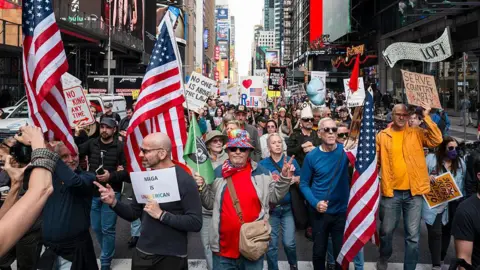
This weekend's 'No Kings' protests pulled in an estimated multitude of participants around the United States to demonstrate against President Donald Trump's agendas and his readiness to stretch the boundaries of presidential authority.
It was a opportunity for likeminded Democrats, liberals and some Republican dissenters to join forces at a period when the liberal faction has little official authority in national politics.
But where do they go at this point?
Huge Participation Outstrips Projections
By most accounts, the turnout at the recent events - in major US cities like the Windy City, New York, Washington and Los Angeles, as well as numerous lesser communities – was greater than anticipated and exceeded the first 'No Kings' demonstration in June.
Congressional Republicans had cautioned that the protests would be against national interests, and several Republican state leaders had put their police forces and military reserves on readiness in instance of conflict.
The massive rallies proved to be peaceful – a carnival, not carnage. In New York City, there were zero demonstration-linked detentions, and the gathering in Washington DC showcased parents and children and young children.
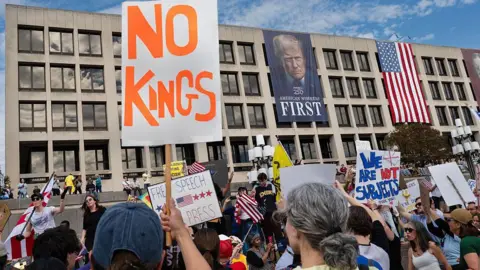
"Today throughout the United States in figures that may eclipse any previous occasion of protest in our American legacy, Americans are proclaiming forcefully and proudly that we are a free people, we are not to be a people that can be governed, our leadership is not for sale," a leading legislator announced in his speech to the capital city gathering.
Administration Reaction and Political Implications
In close proximity from the 'No Kings' gathering in the Washington DC, the executive branch answered the demonstrations with disdain.
"Why bother," a deputy press secretary wrote in response to numerous press questions about the protests.
The president distributed multiple AI-generated clips on his digital channel of him sporting a royal headpiece, showing an example where he was flying a aircraft that released what appeared to be sewage on the activists.
Although conservative lawmakers may be diminishing the importance of the marches, the scale of the participation – along with the president's predominantly negative approval rating in leading opinion polls - indicates a Democratic Party prospect to recover from recent political setbacks.
The Democratic Party's Obstacles and Internal Splits
The Democratic organization yet encounters a significant journey to achieve success, though.
Research suggest merely a third of citizens approve of it - the weakest for many years - and Democratic leaders are split over ways to mount an successful opposition to the administration when they no longer control either chamber of the legislature.
Liberals took to the streets on Saturday for a multitude of causes. The administration's assertive border policies, his import taxes, his government cuts, his foreign policy, his positioning of state troops in American urban centers and his norm-breaking use of presidential authority were all common subjects of concern and outrage.
Certain elements of the frustration was furthermore aimed at party leadership.
"We continue suffering losses, and we're remaining silent," a particular march attendee in the capital informed media outlets on during the protests. "Understand, I feel we must throw some more elbows. Sadly, the high road is ineffective."
Government Shutdown Tactic and Partisan Risks
The Democrats have been increasingly confrontational over the ongoing budget impasse, which is approaching its fourth week. They have been unwilling to endorse a brief continuation of current national budget without a compromise solution to tackle health-insurance subsidies for financially struggling individuals set to expire at the year's close.
Because of Senate parliamentary rules, Democrats have certain influence although being in the minority – and, at least so far, the general population seems to be assigning at least as much fault for the deadlock to the administration and the GOP leadership.
But the tactic involves dangers as well. The pain from the shutdown – especially for members of the Democratic coalition – is set to worsen as the duration progress.
Various government employees have missed salaries and are facing monetary struggle. Monetary resources is expected to run out for low-income food support. The justice department is cutting back its functions. And the Trump administration is using the impasse to direct further cuts to the public sector staff and freeze national expenditures, aiming at liberal-leaning regions and metropolitan areas.
Forthcoming Votes and Partisan Prospects
The truth is that party representatives in the Senate will finally have to discover a resolution of the emergency. But they may be struggling to establish terms that the activists who took to the streets on Saturday will find acceptable.
"If|In case|

